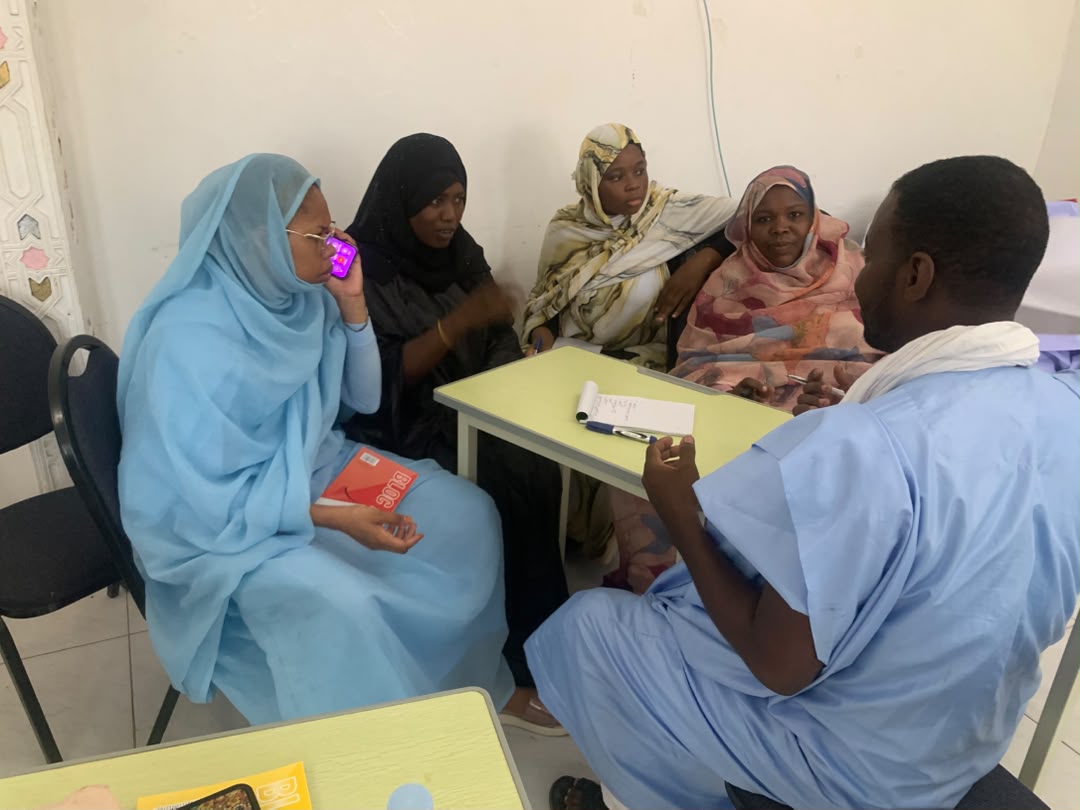

A one-day workshop organized by Free the Slaves gave members of local human rights organizations the legal knowledge and practical skills to identify cases, refer them to the right services, and support survivors.
The workshop opened with an icebreaker, followed by a series of serious discussions. The 28 participants, who included association leaders, activists, and human rights defenders from local civil society organizations, gathered on September 29 to study modern slavery, human trafficking, and the national and international laws that address them.
Dame Ba, who represents Free the Slaves (FTS) in Mauritania, opened the day by outlining the purpose of the training: to build a new group of paralegals to support survivors and others in need. Lead consultant and trainer Oumar Amadou Mbaye facilitated the sessions in French and Arabic, with support from Mr. Ba. Each session encouraged active participation through group work, plenary feedback, guided discussions, and daily evaluations.
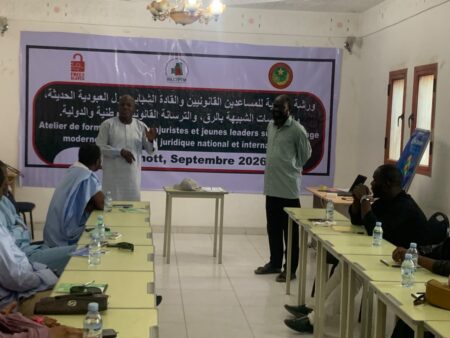
Mr. Ba engaging in a discussion in an ongoing session
Modern slavery worldwide and in Mauritania
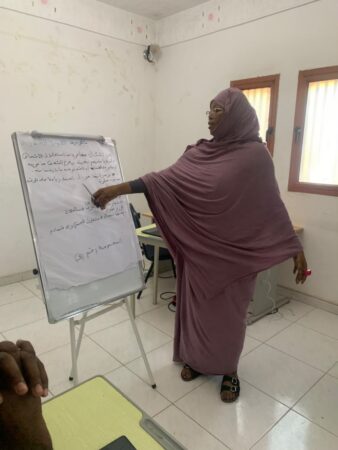
Participant presenting group activity
The first module set out the scale of the issue. According to the International Labor Organization (ILO), modern slavery includes forced labor, debt bondage, forced marriage, and human trafficking. The latest joint global estimates from the ILO, the International Organization for Migration (IOM), and Walk Free found that about 50 million people were living in modern slavery in 2021: 28 million in forced labor and 22 million in forced marriage. That is roughly one in every 150 people in the world.
Mauritania has no official statistics on modern slavery. The 2018 Global Slavery Index estimated that around 90,000 people, or 2.4 percent of the population, were affected. Mauritanian authorities consider these figures exaggerated and used for political purposes. Participants then examined the causes of modern slavery, including poverty, inequality, corruption, and demand for cheap labor. They also discussed its consequences: violence, children kept out of school, early marriage, and confiscated wages.
Knowing the law
The trainers then introduced the legal framework that paralegals will rely on in their work. At the international level, this includes the 1926 and 1956 slavery conventions, the ILO conventions on forced labor, and the 2000 Palermo Protocol. At the national level, participants studied the 2015 law that makes slavery a crime against humanity, Law No. 2020-017 on human trafficking, and the national body established in 2023 to combat hereditary slavery and trafficking.
The second module explained how human trafficking differs from migrant smuggling. Trafficking aims to exploit a person and can happen without anyone crossing a border. Migrant smuggling means helping someone cross a border irregularly in exchange for payment. The module also addressed common myths, such as the belief that trafficking only happens abroad.
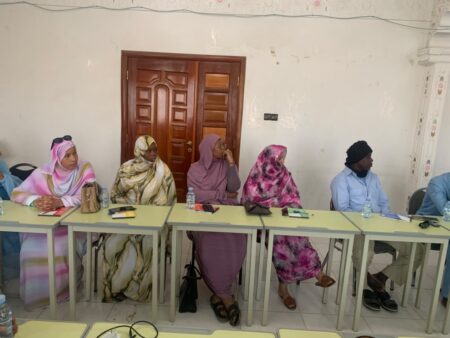
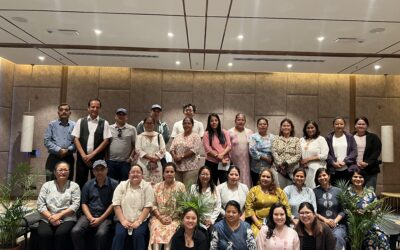
Participants attending the training sessions