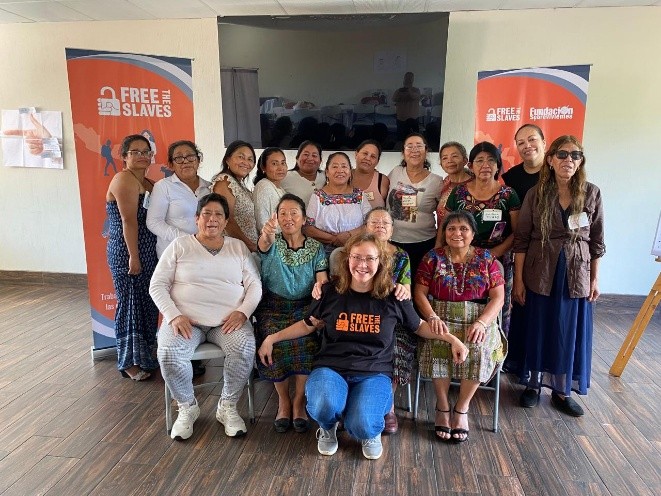

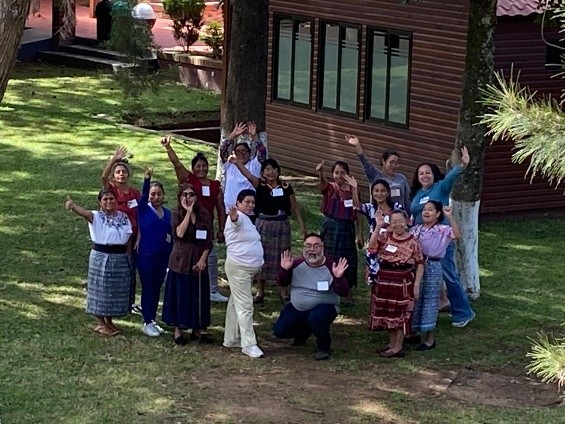
Participants of the workshop
On October 24 and 25, 2026, 16 women from Centro de Apoyo para las Trabajadoras de Casa Particular (CENTRACAP) met in Guatemala for a two-day workshop supported by Free the Slaves (FTS). They came to strengthen their own organization. They also came to prepare for a larger task: building a network of survivors of child labor, including its worst forms. The participants included members of CENTRACAP’s Board of Directors, Advisory Council, and General Assembly, along with one member of its technical team. Over two days, they worked on trust, communication, and teamwork, and they made concrete agreements about how their organization will be run.
Why survivor organizations matter
People who have experienced child labor understand its causes and consequences in ways that outsiders often miss. When they organize, they can shape the programs and policies meant to protect children. A network of survivor organizations gives that knowledge a stronger, shared voice.
This workshop is part of FTS’s wider work in Guatemala. Since 2025, FTS has supported the Government of Guatemala in implementing its national Alliance 8.7 Roadmap for 2026 to 2030, with a focus on bringing survivor perspectives into national policy. Alliance 8.7 is the global partnership working to end forced labor, modern slavery, human trafficking, and child labor. As part of this work, FTS mapped organizations that work with survivors and on the worst forms of child labor. Strong, well-governed survivor organizations are essential if survivors are to take part in these national processes as leaders.
Inside the workshop
The workshop drew on Latin American social psychology and psychosocial supervision. It built on participants’ strengths, promoted their rights, applied a gender perspective, and followed the principle of do no harm. Every activity drew on participants’ own experiences, and they expressed themselves through movement and body language as well as through words. Each activity followed the same pattern: participants received instructions, practiced the exercise, and then reflected together on what they had learned.
The two days were organized around five activities:
- This Time Is Ours. Participants agreed on rules for how the group would work together.
- My Companion Is Like Me. Participants walked together along a wall of memories.
- Untying Knots. Using body sculptures and an “elephant in the room” exercise, participants named governance problems inside the organization that had been difficult to discuss.
- Walking Together. Participants practiced listening and explored what gets in the way of good communication.
- We Are One. The final session focused on caring for one another and planning next steps.
On the second day, participants wrote and approved a set of group agreements. They committed to communicating with one another respectfully and directly. Members will take turns representing CENTRACAP and will report back to the group each time they do. The group also scheduled a regular Board of Directors meeting for November 15. Participants set other rules for how CENTRACAP is governed and agreed on how they will contribute to the new survivor network. These agreements give the organization a clear base for its next stage of work.
What participants said
Fifteen participants completed the evaluation at the end of the workshop. All 15 were satisfied, and 12 of them were very satisfied. Fourteen said the workshop was very useful. The parts they valued most were learning assertive communication, reaching agreements together, and recognizing the group’s collective resilience. In written messages to FTS, participants thanked the team for the workshop and for the knowledge it shared. Some connected the workshop directly to CENTRACAP’s needs. They thanked FTS for its support “to improve our communication” and stressed the value of ongoing training. Others wrote short notes of thanks, such as “excellent work.”
Looking ahead
Several participants asked for the workshops to continue. One asked for more sessions on healing “to overcome problems” and requested another training. Another said she hoped to stay in contact with FTS. These requests reflect a group that is ready to keep building, both as an organization and as part of a wider survivor network.
FTS will continue to support survivor organizations in Guatemala as they take on leadership roles in efforts to end child labor and modern slavery.