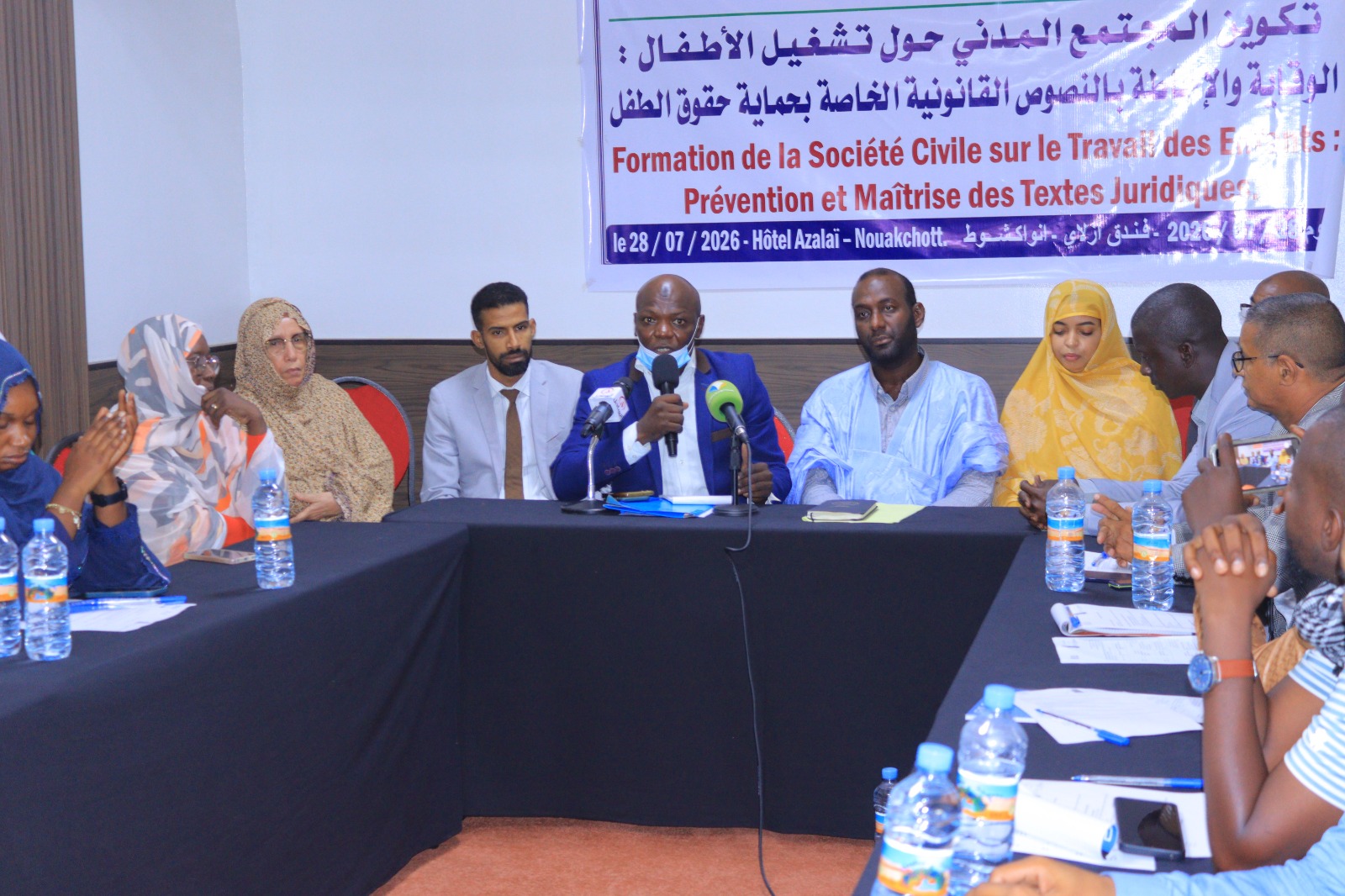

Ending child labor requires more than awareness. It requires the people closest to affected communities to understand and apply the laws designed to protect children. That was the premise behind a training we held with SOS Esclaves in Nouakchott, Mauritania, on July 28, 2026, bringing together thirty civil society actors from across the country’s human rights sector.
The training sits within a broader program in Mauritania, where we work with local partners including SOS Esclaves, the Association Mauritanienne de Lutte contre la Dépendance (ALCD), and the Initiative de Résurgence Abolitionniste (IRA) to strengthen legal literacy, civic documentation, and rights-based reporting among communities most exposed to modern slavery’s legacies, including Haratine communities. A network of paralegals trained through the program helps community members navigate the process of obtaining birth certificates and national identification documents, civic papers that are often a first step toward accessing education, employment, and legal protection. A separate network of journalists, trained through the program on rights-based reporting, now covers modern slavery and human rights issues across Mauritania’s radio, television, and print outlets.
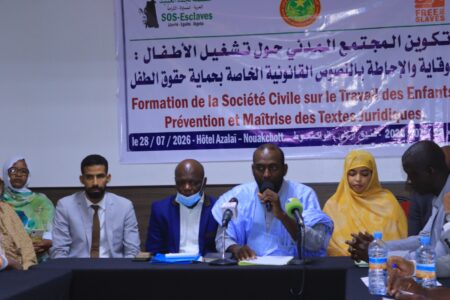
The President of SOS-Esclave welcoming the officials and participants
We have also worked for five years to help translate the country’s Alliance 8.7 Pathfinder commitments into institutional capacity. In February 2025, we partnered with the International Labour Organization (ILO) and Mauritania’s National Instance Against Human and Migrant Trafficking to evaluate the country’s Alliance 8.7 roadmap, work that has since informed a series of capacity-building trainings and a national forum, co-organized with IRA, bringing together civil society, journalists, human rights advocates, and state institutions to discuss the roadmap’s implementation. Dame Bâ, our Country Program Coordinator for Mauritania, described the July training’s goal as helping civil society translate national and international legal texts on child labor into practical understanding they can use in their own communities.
The training also marked a moment of transition for SOS Esclaves. Mohamed Ould MBareck, elected president after the death of founder Boubacar Ould Messaoud, used the occasion to affirm the organization’s continued focus on children, citing gaps in civil registration, school access, and protection services as unresolved challenges. Aminetou Mint Mokhtar, president of the Association of Women Heads of Household and a longtime collaborator of Ould Messaoud, spoke to thirty years of shared work on human rights in Mauritania.
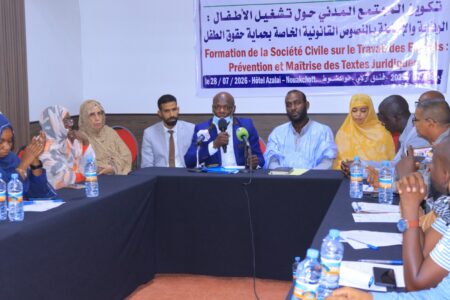
Dame Ba, Mauritania Country Coordinator for Free the Slaves thanks partners and participants
A representative of the National Instance Against Human and Migrant Trafficking opened the session by placing children at the center of the country’s anti-trafficking priorities, and by framing civil society’s monitoring role as complementary to the state’s own institutions and legal commitments.
This training workshop also brought toghther an official from the ministry of public service and labor, a respsentif of the High Commissionner for the Human Right in relation with the civil society and 30 paticipants from 16 civil society organizations to discuss, learn and refresh about the child labor and its Law and judiciary arsenal
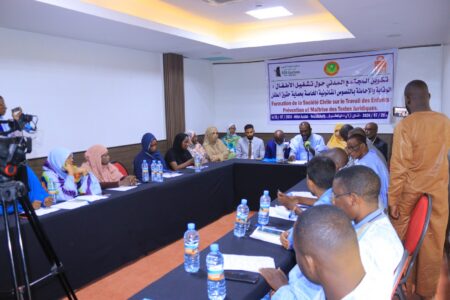
Official opening of the training workshop
Participants worked through Mauritania’s domestic legal framework, including the Labor Code, the 2005 ordinance on penal child protection, and the National Children’s Council, alongside international standards such as the ILO’s Convention No. 182 on the worst forms of child labor, Convention No. 138 on minimum age, and the Convention on the Rights of the Child. The day ended with participants drafting action plans to carry the training’s content back into their own organizations’ work.
Multiple media outlets covered the event.
https://www.futureafrique.net/node/19946