
Community monitors can identify risk factors. Corporate sustainability staff can recognize warning signs. But when a report of a human rights violation formally reaches an investigator or social worker, something different is required: legal knowledge, investigative methodology, ethical standards, survivor-centered interviewing skills, and the documentation practices that turn a credible report into an actionable record.
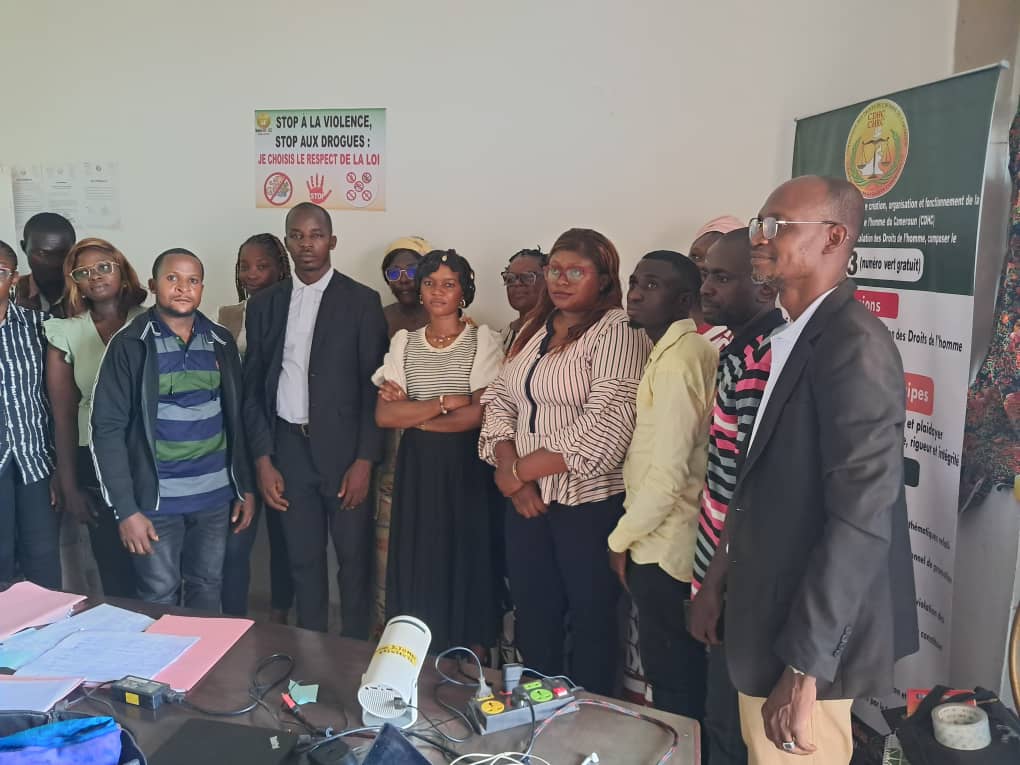
On June 8 and 9, 2026, Free the Slaves (FTS) and the Cameroon Child Rights Civil Society Organizations Network (CAM-CRIN), with support from an industry partner, convened a two-day investigator training workshop at the regional office of the Commission on Human Rights of Cameroon (CDHC). Approximately 15 investigators, social workers, and government representatives gathered to enhance their skills in these areas. Participants included officials from the Ministry of Social Affairs (MINAS) and the Ministry of Labor and Social Security (MINTSS), investigators from Bertoua, Yokadouma, and Messok, and a representative of the CDHC East Region.
The East Region workshop is the first in a series targeting five cocoa-producing regions across Cameroon: East, Littoral, Centre, West, and South. What was built over these two days will inform how training is designed and delivered across all of them.
A Shared Foundation
The first day began with discussion on the legal and conceptual groundwork. Led by the Head of the CDHC regional office, the opening sessions covered the key legal instruments protecting against forced labor, child labor, human trafficking, modern slavery, and gender-based violence (GBV), along with the specific provisions relevant to cocoa-growing communities.
From there, the training addressed definitions and distinctions between these concepts for a group of participants who came with different professional backgrounds and working vocabularies. When an investigator from Bertoua and a social worker from Yokadouma apply different definitions to the same situation, their documentation will not align, their referrals will be inconsistent, and coordination across agencies will break down. A shared conceptual framework is the foundation of a functional response system.
Sessions on investigative methodology and the ethics governing human rights inquiries followed, with group exercises applying these principles to practical scenarios. The day closed with a dedicated session on Sustainable Development Goal (SDG) 8.7, the global commitment to eliminate forced labor, modern slavery, child labor, and human trafficking, connecting the work in Cameroon’s cocoa belt to the international frameworks that reinforce and give weight to it.
Learning to Listen
Day 2 opened with reflections from the previous day before turning to one of the most practically significant elements of the workshop: survivor-centered listening and interviewing skills.
Investigators working directly with people who have experienced exploitation carry a particular responsibility. The way a question is asked, the environment in which a conversation takes place, and the degree to which an investigator can signal safety and respect all shape whether a person feels they are able to speak openly. A well-conducted interview, grounded in dignity and ethical care, yields accurate information and supports the wellbeing of the person being interviewed. Participants practiced these skills through simulation exercises, taking turns as investigators and as survivors or their representatives. Role-play of this kind is where principles become practice, where participants work through the difference between knowing what ethical interviewing requires and being able to do it with care and confidence.
The afternoon moved through the operational architecture of the response system: referral mechanisms and follow-up procedures, standard operating procedures for working with child victims, data collection tools and documentation formats, and human rights violation reporting frameworks. Participants also received an orientation to the industry partner’s Human Rights Response Protocol and relevant standard operating procedures. By the close of the second day, the group had moved through the full arc from legal foundations to the practical tools they will use in the field.
Building Something That Scales
Investigators will apply their training in field-level identification and documentation. CAM-CRIN and FTS will provide follow-up monitoring and coaching to support that application, and the lessons from the East Region will directly inform how training is delivered across the four remaining target regions.
The goal is a coordinated response architecture across Cameroon’s major cocoa-producing regions, one in which investigators, social workers, and government representatives share frameworks, documentation standards, and referral pathways. When that architecture is in place, a report made in a cocoa-growing community does not fall into a gap between institutions. It reaches someone who knows exactly what to do next.