
For survivors of human trafficking, returning home is the beginning of a long and complex journey of rehabilitation, reintegration, and resilience. After exploitation, survivors often find themselves without stable housing, employment and income, or access to healthcare. The stigma that they may encounter within their society, community, and family further adds to the challenge of rebuilding their lives and risks reinforcing survivors’ internalization of blame and shame. In such contexts, the conditions that contributed to trafficking in the first place are hard to address, making survivors vulnerable to re-exploitation.
So what does it actually take to rebuild a life after trafficking?
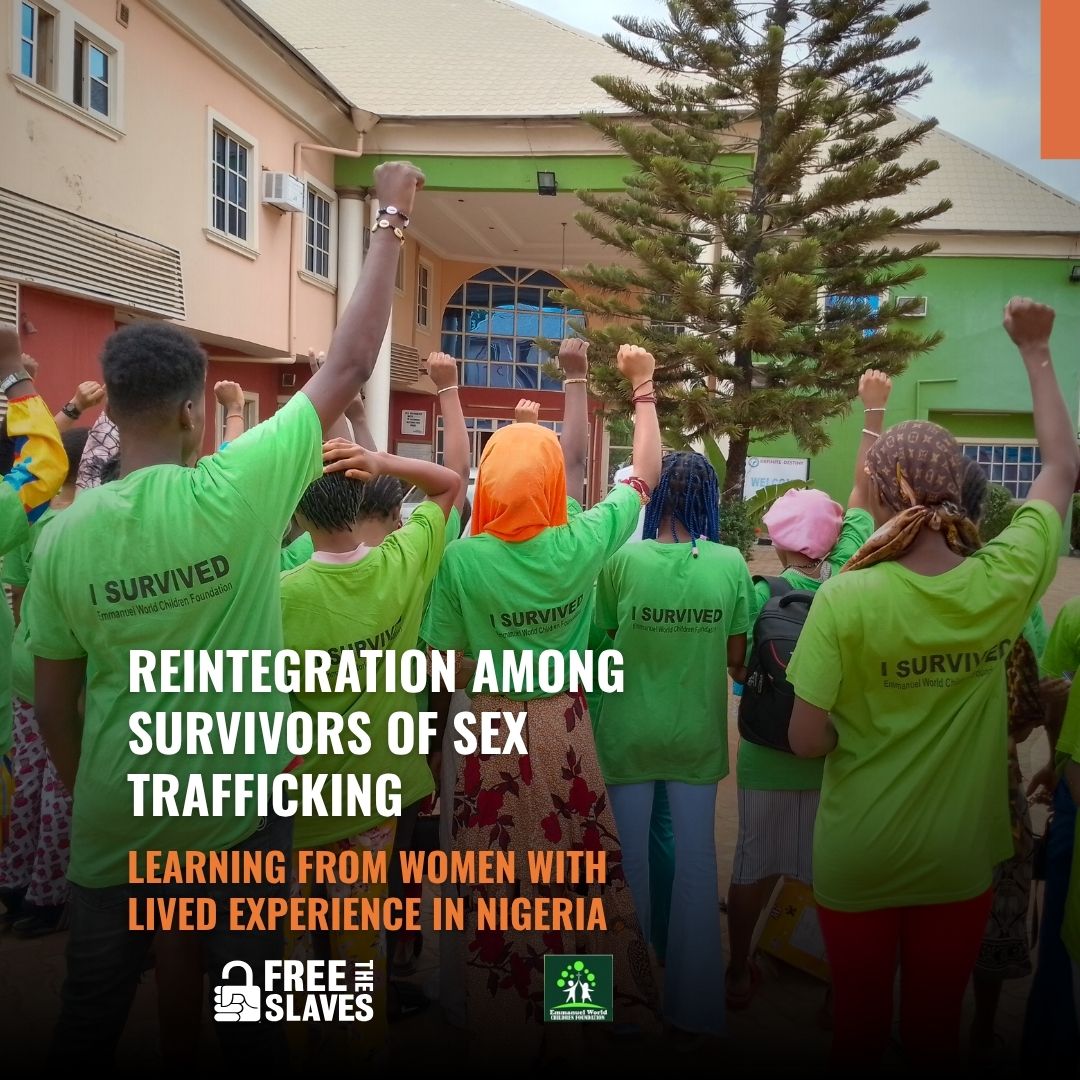
A new research report by Free the Slaves and Emmanuel World Children Foundation, Reintegration Among Survivors of Sex Trafficking: Learning from Women with Lived Experience in Nigeria, asked this question directly to women who had experienced trafficking and subsequently returned to Nigeria. The findings point to a simple but important conclusion: reintegration cannot be reduced to a single intervention. It is a long-term, interconnected process.
Getting trained and finding a job is important, but it is not (always) enough
Economic independence is central to rebuilding a life in dignity and confidence. Survivors highlighted the importance of vocational training. However, a training certificate alone does not necessarily create a sustainable livelihood. Training needs to reflect both a survivor’s interests and the realities of the local economy. Survivors may also need equipment to start their own business or support to enter formal employment, for instance through agreements with local business owners. They may also need help with budgeting, saving, and business management. For some survivors, self-employment can be particularly important, especially in those social and cultural contexts in which stigma and discrimination make accessing formal employment difficult. In those situations, establishing an independent livelihood becomes a crucial source of both income and autonomy.
Healing in the body and the spirit is also part of reintegration
Economic support, however, cannot succeed if survivors are struggling to recover from trauma. The research found that mental health, physical health and, for survivors who value it, spiritual support can be fundamental to rebuilding confidence, trust in self and others, and a sense of purpose. Some survivors described continuing to feel psychologically trapped by their experiences long after they had physically left situations of exploitation, confirming that being physically free does not automatically mean being psychologically free. Reintegration programs therefore need to provide trauma-informed mental healthcare and timely physical healthcare, including sexual and reproductive health services, alongside other forms of assistance.
A safe place and a network of supportive people matter
Housing is another important foundation because it is difficult to focus on healthcare, training, or employment when someone does not know where they will sleep or does not feel safe where they live. Beyond having a safe place, stability also involves having supportive relationships with family, friends, peers, and/or social workers, which can reduce isolation, strengthen resilience, and help survivors navigate the many practical challenges of rebuilding their lives. Where family support is not available, survivors noted that peer networks can provide an especially important sense of belonging, allowing them to connect with others who have had similar experiences and directly understand their feelings and challenges.
Reintegration takes time, and it is rarely a linear process
One key message from the research is that reintegration does not happen through short-term, siloed interventions but rather requires a comprehensive approach whereby support is provided simultaneously in different areas of life. Progress in one area, in fact, can enable progress in another: better mental health can make it easier to participate in training; stable housing can make employment possible; supportive relationships can strengthen confidence in one’s capacity and agency.
The reverse is also true: a setback in one area can undermine progress elsewhere. This is why continuity matters and survivors need reliable follow-up, realistic communication and support that can adapt as their circumstances and priorities change. Short-term or fragmented interventions, on the other hand, can disrupt recovery and undermine trust.
What needs to change?
The research points to actions for everyone involved in supporting survivors.
- Service providers should offer comprehensive, survivor-centered support; involve survivors in decisions about their own pathways; provide market-relevant training alongside start-up resources or employment pathways; support financial literacy; address mental and physical health and spiritual needs; strengthen peer and family networks; and provide consistent, long-term follow-up.
- Governments and public authorities should ensure access to safe and stable housing, address stigma and structural barriers, coordinate reintegration services and referrals, and create the conditions for longer-term, flexible support.
- Employers and the private sector can help by adopting non-discriminatory hiring practices, providing safe and decent working conditions, creating apprenticeships and other pathways into employment, and recognizing skills acquired through reintegration programs.
- Families and communities also have an essential role. Survivors should be welcomed without blame or judgment, supported emotionally and practically, and protected from gossip, harassment and exclusion. Communities can help replace narratives of shame with greater understanding of recovery and resilience.
- Funders need to recognize that successful reintegration cannot always be demonstrated through short-term numbers or outputs. Funding should thus support comprehensive approaches and allow enough time for recovery, changing needs and different trajectories.
Ultimately, reintegration is about creating the conditions in which survivors can build a future with dignity, agency, and freedom. As one survivor who took part in this research explained, the question is not simply whether survivors can return home. It is whether they can build a future there. That future requires sustained support, meaningful choices, opportunities, healing, and communities willing to make space for survivors to thrive.