
Editor’s note: This is the third part in a series of blog posts written by longtime Free the Slaves supporter Carol Metzker. Carol has been writing about her visit to Punarnawa ashram in India, where girls who have survived slavery heal and rehabilitate. (You can read her earlier articles here and here.) Today, she writes about a donation of a “tiny herd of cows” has given the survivors daily food to eat—in the form of fresh dairy, as well as compost for gardens. Extra dairy is also sold at the nearby market. Small donations make a big difference to our frontline projects. To donate to Free the Slaves, go here.
Because of a tiny herd of cows, a cow shed and a bio-gas system donated to Punarnawa, the ashram has enough dairy products to feed 26-30 residents daily, enough methane (from the bio-gas system’s processing of cow manure) to cook meals, and compost for their gardens. 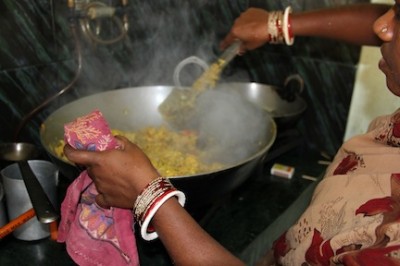 There is also enough extra milk to sell at the market to generate income to pay for the cows’ vet bills and extra feed. In the mornings, the milkman rides his bike to the center, picks up the extra milk and rides off to sell it at the market. Even a worker from the nearby village who helps with the cows, paid in milk, benefits from the project.
How does a bio-gas system work? Cow dung, mixed with water and cow urine, decomposes in an underground digester. Methane rises to the top of the digester and travels through a valved pipe to the kitchen and to a stove. The leftover decomposed mixture—minus methane—leaves the digester and flows into a shallow pit where it can be gathered for use as compost.