Slavery Survivor Returns to School — As a Teacher

As the school year begins, it’s important to recognize that teaching is a profession that often requires bravery. But one teacher in India, Daulati Kumari, brings a special kind of bravery to her classroom. Daulati escaped slavery only a few years ago, and now she teaches children in a Free the Slaves program in communities […]
August 20, 2013

As the school year begins, it’s important to recognize that teaching is a profession that often requires bravery. But one teacher in India, Daulati Kumari, brings a special kind of bravery to her classroom.

Daulati escaped slavery only a few years ago, and now she teaches children in a Free the Slaves program in communities where slavery is rampant.

Daulati was kidnapped by a man who had offered to take her to a doctor. Instead, she was sold into a forced marriage and enslaved for five months. Her parents alerted volunteers affiliated with MSEMVS, a frontline organization that receives funding and training from Free the Slaves. They went to court to force local police to help.

After Daulati was free, she enrolled at the Free the Slaves Punarnawa Ashram, where survivors recover and prepare to return to normal life. She studied hard at the ashram’s school, and when she was ready, she decided to join MSEMVS as a teacher.
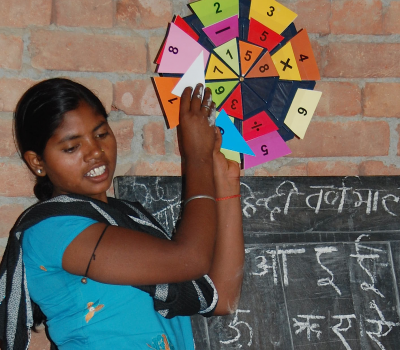
daluti teaching 1“I never imagined that I would teach children,” Daulati says. “I learned a lot in the ashram.”

She’s seen as a local hero at small schools in isolated communities where violent thugs enslave families and traffic children.

“They are intelligent kids,” she says, but formal education “is difficult because they have never been to school. I sit with each child, and hold their hand.”

Daulati knows the risks she is taking. But she also knows that without education, children are vulnerable to slavery. She is an emerging leader in a growing movement to create a generation that will live in freedom.

That is what sets Free the Slaves apart: we are building a movement of survivors, of people around the world who are standing up to slaveholders.  Last year alone, we helped free more than 1,750 slaves and educated more than 14,000 community members how to resist slavery.

Daulati is doing her part. Will you do yours?

Please consider making or renewing your donation to Free the Slaves today. Our program is working, but without support from you, slaves wait. End the wait. Make a gift. Help us build a future without slavery.

Can you help end the conditions that cause modern slavery?

Related Posts

From Planning to Action: Grassroots Leaders Advancing Anti-Trafficking and Safe Migration Efforts

From Planning to Action: Grassroots Leaders Advancing Anti-Trafficking and Safe Migration Efforts

When community members are equipped to lead, lasting protection becomes possible. In eastern Uttar Pradesh, 22 grassroots leaders from Migrant Vigilance Committees and Azad Shakti Abhiyan groups recently completed Community Action Plan workshops, translating a year of training into structured, village-level strategies to prevent exploitation, promote safe migration, and connect vulnerable families to support. Here is what that looks like in practice.

read more
Empowering Partners Through Community Maturity Toolkit Training

Empowering Partners Through Community Maturity Toolkit Training

Sustainable change starts with communities leading their own path to freedom. Through a recent training on the Community Maturity Toolkit, Free the Slaves and partners equipped local organizations in India and Nepal with a practical approach to assess progress, strengthen resilience, and build long-term, community-led solutions to prevent trafficking and modern slavery.

read more
When Crisis Strikes, Migrant Workers Need More Than Emergency Response

When Crisis Strikes, Migrant Workers Need More Than Emergency Response

Migrant workers in crisis settings often face compounded risks, including restricted mobility, withheld documents, and limited access to information, that reflect deeper structural vulnerabilities in migration systems. Free the Slaves’ community-led approaches, including Migrant Vigilance Committees and the SAFE TIPS Guide, help workers prepare before they leave home, strengthening their ability to navigate uncertainty and reduce vulnerability to exploitation.

read more