
Free the Slaves staffers helped lead an important conference in Peru earlier this month to develop anti-trafficking strategies throughout the Americas.
The two-day event was called “Strategic Coordination between Governments and Civil Society for the Integral Protection of Victims of Trafficking in Persons.”
It’s a long title, but a simple mission: how can civil society groups like FTS and our frontline partner organizations teach governments what they need to do to end slavery. In particular, conference participants were looking for fresh ways to help slavery survivors stay free once they’ve escaped bondage.
FTS Haiti Director Smith Maximé explained to the conference how poverty and isolation combine to create restavék child domestic slavery. Thousands of children are sent to cities each year in Haiti to be household servants.
“In Haiti,” Smith noted, “low-income parents hope to provide their children a better future. Often families believe their children will be able to attend better schools if they send them away.”
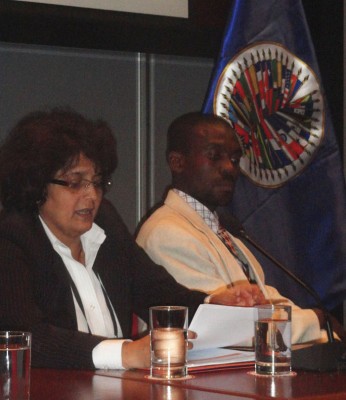
Supriya Awasthi and Smith Maxime at Peru conference | OAS photo
Smith noted that once parents learn about the abuse that child domestic slaves endure in the city, and that their children aren’t getting an education away from home, parents work to get their children back. Providing schooling in rural settings can help prevent children from being sent away in the first place.
The conference in Lima was the first time that FTS South Asia Director Supriya Awasthi had briefed activists from outside Asia. She had been invited to educate anti-trafficking advocates about techniques that are working to eradicate slavery in India.
“I shared my experiences of addressing slavery and trafficking through community-oriented field models,” Surpiya says. She explained how community vigilance committees challenge slaveholders and traffickers, demanding the release of enslaved individuals. Citizen groups often alert local police to help.
“Civil society, alongside government, is playing an important role,” she says.
This month’s conference was just one of several meetings to be conducted by the OAS as it crafts a master strategy to combat trafficking throughout the Americas. Free the Slaves would like to thank the OAS for including us in the development of this initiative to help end slavery in the Western Hemisphere.
Learn about FTS field projects in India and Haiti on the FTS website. Learn about OAS anti-trafficking efforts on the OAS website.