From Victim to Liberator: The Story of Munnu (Part 1)

He seemed hopeless and anxious two years ago, when FTS South Asia Director Supriya Awasthi first met him. Supriya was visiting the Indian village of Bahari, where residents had broken free from slavery at a brick kiln. The villagers helped Munnu escape too. But he was distraught and depressed because his family was still enslaved. […]
January 8, 2013

He seemed hopeless and anxious two years ago, when FTS South Asia Director Supriya Awasthi first met him.

Supriya was visiting the Indian village of Bahari, where residents had broken free from slavery at a brick kiln. The villagers helped Munnu escape too.

But he was distraught and depressed because his family was still enslaved. The slaveholder had taken his 10-year-old son to his house, and Munnu had lost contact.

Bahari residents had organized a community vigilance committee to ensure that villagers remained free from slavery. The committee decided they would help reunite Munnu’s family.

“All of them will be rescued,” the committee reassured Munnu, “as we were rescued and now we’re free.”

This gave Munnu courage.  He contacted authorities, with help from the FTS partner organization MSEMVS. They pressed police and the Labor Department, who then organized a raid. Not only was Munnu’s family rescued, but 22 people in all — men, women and children — moved from slavery to freedom.

Activists kept up the pressure even after the rescue. And it worked. The government provided compensation to all the rescued laborers. Four members of Munnu’s family (including Munnu’s 10-year-old son) received the equivalent of $400 dollars each.

Last year, Supriya visited Bahari again. Munnu was in different spirits now that he has control over his life. He showed Supriya the bicycle rickshaw that he uses in his small business.
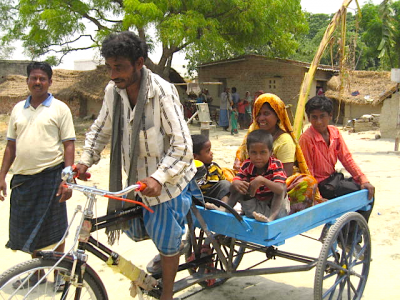
Munnu with family

Munnu with his family in freedom | Supriya Awasthi photo

“It was my dream to own one,” he said.

With the family’s compensation, they bought a small plot of land.

They will also have a decent home, thanks to a housing grant they received as part of their compensation.

Munnu’s wife says that her bargaining power with local landowners has changed now that she is free.

“I refuse to work without wages,” she said. “I do not even accept low wages.”

The family could have settled into a quiet and peaceful life. But there’s more to this story.

Just as the people of Bahari wouldn’t allow Munnu’s family to remain in slavery, Munnu has decided that he cannot tolerate others being enslaved.

Munnu has been passing on his gift of freedom. We’ll have more on his secret mission to free 25 other families later this week in the FTS blog.
 

Can you help end the conditions that cause modern slavery?

Related Posts

Mr. Bachelal’s Path from Surviving Exploitation to Leading Others to Freedom

Mr. Bachelal’s Path from Surviving Exploitation to Leading Others to Freedom

Mr. Bachelal, once trapped in bonded labor, turned his experience into empowerment through Free the Slaves’ Community Liberation Initiative training. Equipped with a deeper understanding of labor rights, legal frameworks, and advocacy, he used his learning to secure the release of five workers held in forced labor—and to begin mentoring them into survivor leaders themselves. His story is a testament to the transformative power of knowledge: when survivors are informed and connected, they not only reclaim their freedom—they help ensure others never lose theirs.

read more
Leadership for Liberation: Strengthening Azad Shakti Abhiyan

Leadership for Liberation: Strengthening Azad Shakti Abhiyan

As part of Free the Slaves’ Community Liberation Initiative, survivor leaders from Azad Shakti Abhiyan gathered in September for a two-day training on Liberation, Care, and Rehabilitation. The workshop deepened their knowledge of trauma-informed care, victim identification, and reintegration—empowering participants to take action against trafficking and support survivor-centered rehabilitation. By investing in survivor leadership, this initiative strengthens grassroots resilience and builds a sustainable, community-driven response to modern slavery in India.

read more
Stronger Together: Building Survivor-led Change in India

Stronger Together: Building Survivor-led Change in India

Survivors of slavery are not just reclaiming their own freedom—they are leading the charge to protect others. In August 2025, Free the Slaves hosted a two-day training in India as part of our Community Liberation Initiative, equipping survivor leaders with the knowledge, tools, and confidence to prevent exploitation in their communities. From learning the roots of modern slavery to developing strategies for awareness and advocacy, participants demonstrated the power of transformation: once victims, now champions for change. Their stories show how one empowered life can spark freedom for many more.

read more