
Editor’s note: This is the fifth and final post from guest blogger Carol Metzker. Carol is a longtime supporter of Free the Slaves. She recently visited our frontline work in India. In this series of articles, she writes about the Punarnawa ashram, a shelter for girls and women who are survivors of sex trafficking. Today, she talks about Community Vigilance Committees (CVC). Free the Slaves and our frontline partners have learned that a community that stays vigilant against predatory slave traffickers, tends to stay free. Learn more about our frontline programs here. And you can read Carol’s past blog posts here, here, here and here.
In a remote hamlet of India near the borders of Nepal and Bangladesh, villagers crowded under the eaves of thatched roofs and in the shade bamboo trees. They observed us as we sat on mats covering the ground. We met with men, from the hamlet and from a neighboring village, who gathered to discuss ways to protect their families against human trafficking and slavery.
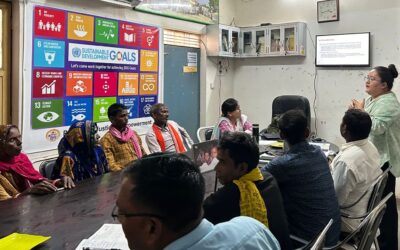
Free The Slaves educators, their local partners, and an established Community Vigilance Committee (CVC) from a nearby area had stepped in after two 12-year-old boys from this community were trafficked with five other local boys the previous year. The boys were rescued before they had reached their intended work site in Delhi, but they needed help from a rehabilitation center for children rescued from slavery before returning home. The educators and concerned neighbors began to inform the villagers of their human rights and to teach them how to safeguard additional children from slavery.
With nearly no access to schooling, and freedom not guaranteed in the region, the villagers did not know that liberty is every human’s right. The families who gathered in the most humble setting—without benches, whiteboards, slide presentations, books or handouts—learned at the CVC meetings that children’s education is free and compulsory by law, that citizens are entitled to converse with elected leaders and that they are entitled to work at jobs that provide pay. These basic fundamentals provide a kind of inoculation against enslavement—protection from slavery’s root causes of illiteracy, poverty and vulnerability.
The man who headed the other village’s committee spoke to us. His son had been trafficked and rescued a few years earlier. Knowing firsthand the heartache of nearly losing a child, the father helped his own village committee become strong to guard its community members and then sought to help nearby communities learn to protect themselves.
Since the educators and other villagers’ committee had been working in the hamlet, not a single child had been trafficked. Families without food and out of work, in a village that already existed well below the poverty line, were getting assistance with food and finding access to healthcare. Villagers were becoming aware, educated and less vulnerable.
Thanks to Free the Slaves and the people who support its efforts, change is taking hold.