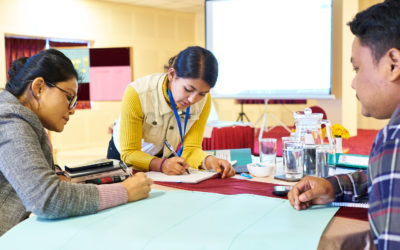
The Importance of Being Heard

In Nepal, we call the news media a “third eye.” They play a vital role in development by minimizing the gap between the public and government. They alert the public by exposing hidden issues. If your group and your cause are covered by the media, there is stronger pressure for social justice and change. That […]
July 10, 2012

In Nepal, we call the news media a “third eye.” They play a vital role in development by minimizing the gap between the public and government. They alert the public by exposing hidden issues. If your group and your cause are covered by the media, there is stronger pressure for social justice and change.

That is why a new radio program has been launched this year by the Alliance Against Trafficking in Women and Children in Nepal (AATWIN). The alliance is a frontline partner of Free the Salves. AATWIN works to raise a strong and collective voice against human trafficking.

The new show is called “In Course of Life,” and airs on Citizen FM. The program broadcasts news about community developments to resist and overcome slavery around the country, providing a platform for slavery survivors and activists to speak. It builds an essential bridge between grassroots community work and national policymakers.

“Working with media became essential today,” says AATWIN Program Coordinator Benu Gurung. “It helps us bring our voices strongly to the wider community.” The show is heard in 32 districts of Nepal, reaching nearly half the country.

In Course of Life is just 30-minutes long, every other week. But it is amazing what even a short program can accomplish. As Nepali officials consider strengthening the country’s laws to combat slavery, it’s vital that the voices of people who know the impact of slavery first hand are being heard.

Read more about our other innovative projects on our Nepal webpage.
Can you help end the conditions that cause modern slavery?

Related Posts

From Research to Action: Advancing Change for Child Domestic Workers in Kathmandu

From Research to Action: Advancing Change for Child Domestic Workers in Kathmandu

In Kathmandu, thousands of children work behind closed doors as domestic workers, largely unseen and unprotected. A new report from Free the Slaves and CWISH Nepal brings their experiences into focus and examines the structural forces that sustain child domestic labor. But research alone is not enough. This work moves beyond documentation to action, engaging employers, civil society, local government, and children themselves to drive coordinated change rooted in evidence and lived experience.

read more
Shedding Light on Hidden Exploitation: Research Dissemination on Child Domestic Workers in Kathmandu, Nepal

Shedding Light on Hidden Exploitation: Research Dissemination on Child Domestic Workers in Kathmandu, Nepal

Child domestic labor in Nepal is one of the most hidden and normalized forms of exploitation. Despite legal protections, children from rural and disadvantaged communities continue to be trafficked or sent to work in urban households, where they face long hours, hazardous conditions, and isolation. To shed light on these realities, Free the Slaves (FTS) and CWISH conducted a qualitative study, Life as Child Domestic Workers in Kathmandu, and shared its findings at a dissemination event with government, civil society, and child protection stakeholders. The research highlights urgent gaps in protection and calls for systemic reforms to ensure every child’s right to dignity, education, and safety.

read more
Inside the Hidden World of Nepal’s Child Domestic Workers

Inside the Hidden World of Nepal’s Child Domestic Workers

Behind the closed doors of urban homes in Nepal, thousands of children—mostly from rural villages—work long hours in exchange for shelter, food, or a small wage. Often invisible to the public and absent from national statistics, these children face isolation from friends and family, interruptions in their schooling, and in some cases, hazardous labor.

Our new research with CWISH uncovers the pathways that lead children into domestic work, the daily realities they face, and the factors—poverty, lack of rural education, family pressures—that make them vulnerable. More importantly, it highlights the voices of the children themselves and offers actionable recommendations for government, educators, employers, and communities to create safer, fairer futures.

read more