More than 1,000 People Freed From Slavery

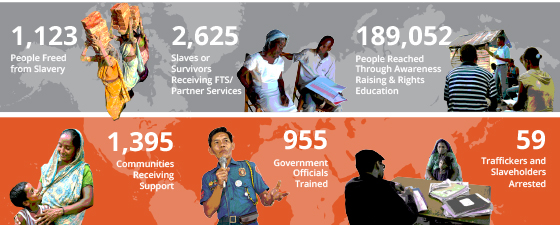
Our 2016 annual results demonstrate that Free the Slaves liberates people from slavery and changes the conditions that allow slavery to persist. We’re not only helping people break free, we’re ensuring they stay free and nobody takes their place in bondage. Here is a by-the-numbers summary of our impact last year: Other 2016 Impact Highlights: […]
May 30, 2017

Our 2016 annual results demonstrate that Free the Slaves liberates people from slavery and changes the conditions that allow slavery to persist. We’re not only helping people break free, we’re ensuring they stay free and nobody takes their place in bondage. Here is a by-the-numbers summary of our impact last year:
Other 2016 Impact Highlights:

DATA SURGE: We have been meticulously monitoring the implementation of our community-based model by in-country partner organizations to evaluate its effectiveness. Our three-year intensive field testing concluded in 2016. Our team is now crunching the numbers. We’ll keep you posted.

NEW COUNTRY: The new “Protect Our Children” project in Senegal aims to stem the flow of children into street begging slavery. Many children are lured from villages to cities by traffickers posing as educators at religious boarding schools. We’re educating parents about the dangers and helping legitimate schools weed-out imposters.

NEW RESEARCH: Harvard University researchers say the FTS model is changing lives in India. A 2016 study found our strategy is “reducing indebtedness and threats of violence, improving wage levels and generating a sense of collective efficacy.” This led to “a strong effect on food security, access to medical care, civic participation and take up of government programs.” Also in India, an FTS pilot project showed that cell phones are an excellent way to educate those in slavery about their rights.

CELEBRATING INNOVATION: Free the Slaves honored the work of Smarthan with a Freedom Award in 2016, recognizing their innovative use of radio to fight poverty and bonded labor slavery in India. The group received a $10,000 prize to expand its work.

Our full 2016 annual report will be available later this year. See previous annual reports here.
Can you help end the conditions that cause modern slavery?

Related Posts

Shedding Light on Hidden Exploitation: Research Dissemination on Child Domestic Workers in Kathmandu, Nepal

Shedding Light on Hidden Exploitation: Research Dissemination on Child Domestic Workers in Kathmandu, Nepal

Child domestic labor in Nepal is one of the most hidden and normalized forms of exploitation. Despite legal protections, children from rural and disadvantaged communities continue to be trafficked or sent to work in urban households, where they face long hours, hazardous conditions, and isolation. To shed light on these realities, Free the Slaves (FTS) and CWISH conducted a qualitative study, Life as Child Domestic Workers in Kathmandu, and shared its findings at a dissemination event with government, civil society, and child protection stakeholders. The research highlights urgent gaps in protection and calls for systemic reforms to ensure every child’s right to dignity, education, and safety.

read more
Inside the Hidden World of Nepal’s Child Domestic Workers

Inside the Hidden World of Nepal’s Child Domestic Workers

Behind the closed doors of urban homes in Nepal, thousands of children—mostly from rural villages—work long hours in exchange for shelter, food, or a small wage. Often invisible to the public and absent from national statistics, these children face isolation from friends and family, interruptions in their schooling, and in some cases, hazardous labor.

Our new research with CWISH uncovers the pathways that lead children into domestic work, the daily realities they face, and the factors—poverty, lack of rural education, family pressures—that make them vulnerable. More importantly, it highlights the voices of the children themselves and offers actionable recommendations for government, educators, employers, and communities to create safer, fairer futures.

read more
Exploitation and Extraction: How Armed Groups are Fueling Modern Slavery in DRC’s Cocoa Sector

Exploitation and Extraction: How Armed Groups are Fueling Modern Slavery in DRC’s Cocoa Sector

The Democratic Republic of Congo’s cocoa sector is growing—but so is the exploitation behind it. New research by Free the Slaves reveals how armed groups and corrupt actors are using violence, forced labor, and smuggling to control cocoa production in eastern DRC. As cocoa beans flow into global supply chains, the human cost remains hidden. This new report examines the links between modern slavery and illicit resource appropriation—and what governments, industry, and the international community must do to stop it.

read more