FTS Senegal Program Gains Widespread Attention & Media Coverage

Last week’s Free the Slaves seminar in Senegal on child begging slavery was a remarkable success. Representatives from the Senegal government, international organizations and local civil society groups gathered to learn how our Aar Sunu Xaleyi (Protect Our Children) project has raised awareness about child trafficking and led to the rescue of many children. In […]
April 1, 2019

Last week’s Free the Slaves seminar in Senegal on child begging slavery was a remarkable success. Representatives from the Senegal government, international organizations and local civil society groups gathered to learn how our Aar Sunu Xaleyi (Protect Our Children) project has raised awareness about child trafficking and led to the rescue of many children.

In Senegal, many families from poor and rural areas send their children away to religious boarding schools (daaras), hoping they will be better cared for. The children (talibés) are often sent on the streets to beg. In the streets or in school, they face many forms of abuse and extremely unsafe conditions, adding to the trauma caused by family rupture. Most talibés enter adulthood deprived of a complete education and unprepared for productive employment, and many are never reunified with their families.

Free the Slaves, working in partnership with ENDA Youth Action and PPDH, have been educating rural parents about abuses that happen to many children who are sent to the city. We’ve opened listening posts in the city where child slaves can reach out for help. And we’re helping school officials to set enforceable standards for children sent to study away from home.

The workshop received extensive press coverage in Senegal, including television.
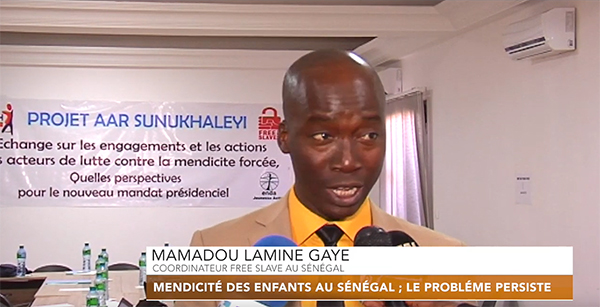
See Senegal newscast coverage here (scroll to 22:26), here (scroll to 2:43) and here (scroll to 4:22).

The session focused on three key areas:

  • Successful examples of strategies and projects to combat forced begging that have yielded satisfactory results
  • Obstacles to the adoption of the law on the status of daaras, the code of the child and the lack of implementation of the 2005 law prohibiting forced begging by children
  • Mechanisms for coordinating interventions and monitoring government commitments

The session was attended by a range of government officials, including presidential advisers on child protection, the Justice Ministry’s anti-trafficking unit, the Labor Ministry’s team to combat the worst forms of child labor and the Health Ministry’s social action team.

Other organizations represented included UNICEF, USAID, La Coopération Italienne, the University of Dakar’s Institute for Human Rights and Peace, Save the Children, Terre des Hommes, Child Fund, Amnesty International and the Association of Quranic Masters.

Learn more about our work in Senegal here.
Can you help end the conditions that cause modern slavery?

Related Posts

Rallying for Urgent Action: Free the Slaves Convenes Strategic Meeting in Dakar

Rallying for Urgent Action: Free the Slaves Convenes Strategic Meeting in Dakar

Free the Slaves convened a high-level strategic meeting in Dakar to confront the rising crisis of sexual exploitation in the gold mining zones of Kédougou. The gathering brought together Senegalese authorities, international partners, and regional experts to strengthen coordination, accelerate protection efforts, and ensure survivor-centered support for the hundreds of girls and women affected. This meeting marks a critical step toward a unified, urgent response to a rapidly escalating humanitarian issue.

read more
A Journey of Hope: Ten Survivors Safely Repatriated from Senegal to Nigeria

A Journey of Hope: Ten Survivors Safely Repatriated from Senegal to Nigeria

Ten young Nigerian women trafficked to Senegal have returned home through a coordinated repatriation mission led by Free the Slaves and partners. Their journey marks not just a return, but a renewal—demonstrating how survivor-centered support, cross-border collaboration, and sustained community mechanisms continue to create pathways from exploitation to empowerment, long after projects formally close.

read more
Building Futures in Akure: Survivors Turn Courage into Opportunity

Building Futures in Akure: Survivors Turn Courage into Opportunity

In Akure, Nigeria, seventeen survivors took their next steps toward independence. Gathered for a two-day workshop hosted by Free the Slaves (FTS) and Emmanuel World Children Foundation—with support from the Center on Human Trafficking Research and Outreach (CenHTRO)—they learned new skills, shared experiences, and received tools to rebuild their livelihoods. What began as a training became a celebration of resilience: survivors standing together, leaders listening, and a community committing to sustained empowerment long after rescue.

read more