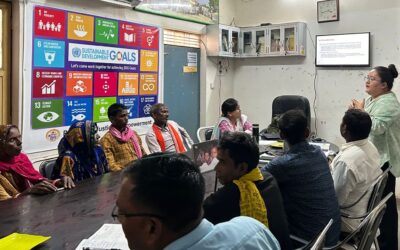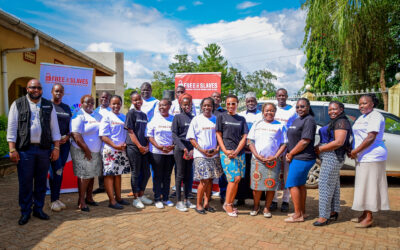

It isn’t often that all five FTS country directors are in the same place at the same time.
But it happened last week in Washington, as our overseas staff briefed the U.S. State Department’s “J/TIP” anti-trafficking team.
The presentation was called “Innovations on the Front Lines of Slavery.”
The briefing began with DRC Country Director Jack Kahorha, who described how FTS conducts field research in order to develop anti-trafficking programs that are customized for each country.
The research goal is to uncover the “types, nature and scale of slavery,” he explained, and then “analyze the characteristics of vulnerability” that cause people to become enslaved.
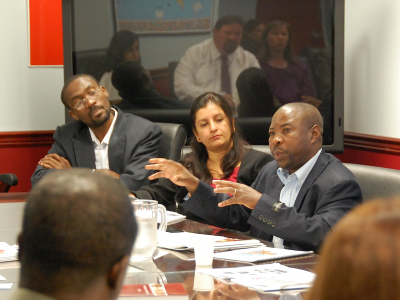
FTS Congo Country Director Jack Kahorha (right)
Ghana County director Joha Braimah came next, explaining that Free the Slaves approaches the challenge of changing local acceptance of slavery by awakening community members to the fact that slavery is illegal and can be overcome through collective action. “The FTS model is not to dole out money,” he said, “but we strive to find committed individuals in the community who want to act as agents of change.”
Haiti Country Director Smith Maximé picked up on this theme, outlining how raising community awareness of child slavery causes parents to shift their thinking about sending children away from home to be domestic servants. “Community members start to think of children as rights holders to protect and respect,” he said.
In India, explained FTS South Asia Director Supriya Awasthi, the model of “psychological empowerment” is working. Not only do villagers take action to free themselves, but they begin to work toward freeing others in neighboring villages as well. “Once they become organized, the freedom becomes contagious,” she said. “They are not just sustaining their own freedom, but they’re also freeing others.”
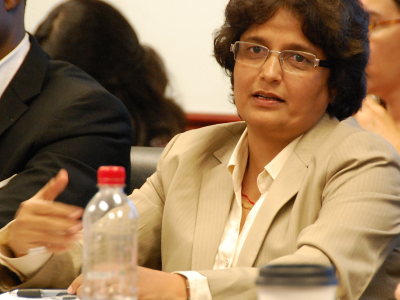
FTS South Asia Director Supriya Awasthi
Nepal Country Director Neelam Sharma concluded by noting that the FTS community empowerment model not only helps people in slavery to break free. It also helps prevent others from taking their place. By providing schooling for children and vocational training for adults, people “gain power,” she said. “There is less risk to be enslaved.”
FTS Executive Director Maurice Middleberg explained that the various elements fit together into a comprehensive approach to combat slavery directly on the front lines: “There is a change process at the community level that is at the heart of the model.”
The State Dept. provides vital funding for FTS projects in several countries, and the department’s top anti-trafficking official, Ambassador Luis CdeBaca, thanked the country directors for their in-person updates. He noted that portraits of great abolitionists in history hang on the walls of his office, and that he sees the work of anti-slavery activists today as following in their footsteps. This is a “universal and timeless struggle,” he said.