
In many of the countries where we work, modern slavery is hidden from public view. But not in Senegal. Child slavery here is evident everywhere. Little boys carrying empty plastic margarine containers cluster on street corners and markets all over Dakar, Saint-Louis and the many villages along major roads. They are trapped in forced begging.
During my visit to Senegal earlier this year, I stopped and talked to a few boys digging through a dumpster in Saint-Louis. They said they were from Guinea-Bissau. They did not know their ages. One boy had a small plastic bag in which he had collected pieces of pencils and chalk so that he could have supplies to do his studies. It was a heartbreaking reminder of the importance of our mission and the dedication and persistence of our local partners and other stakeholders.
Our project in Senegal is called Aar Sunu Xaleyi (“Protect Our Children”). We focus on the trafficking of children from rural villages to the city. Many parents send children to the city for religious education, but unscrupulous traffickers posing as legitimate teachers recruit children and put them on the street as beggars instead.
One of the unique aspects of our project is working in both rural source (Kolda) and urban destination (Saint-Louis) communities. We facilitate communication, rights awareness and safe reintegration of children from forced begging. My mission was to help our front-line partner organizations connect the dots between the fieldwork they do and the results it achieves.
Over the years, Free the Slaves has developed a variety of tools for measuring the results of our community-based approach to ending slavery. With this new project in Senegal, and with new highly-capable partners, we were able to introduce and adapt the tools to a new context at the beginning of the project.
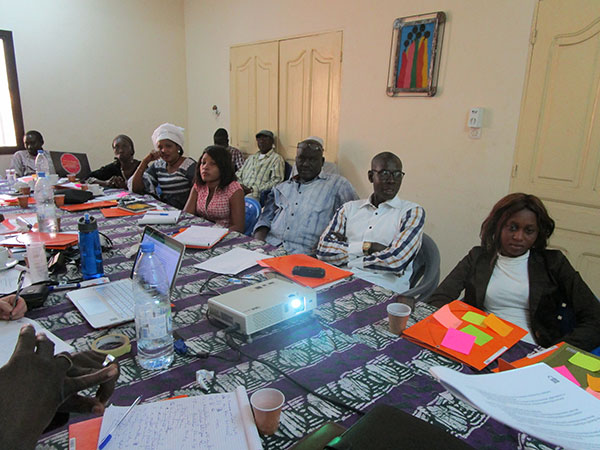
I met with PPDH (Platform for the Promotion and Protection of Human Rights) and immediately went to work helping them conduct the “CoCAT” – the Coalition Advocacy Assessment Tool. This is a participatory tool that was developed in 2016 with the assistance of graduate students from the Harvard Kennedy School. Coalition members discuss and score themselves on objectives, strategies and tactics, advocacy execution, advocacy engagement and influence, and organization and administration. The scores identify key areas of strength and areas of potential improvements.
I then went to Saint-Louis, to spend several days working with staff from ENDA JA (Environment Development Action in the Third World Youth Action). We spent time working on the “OCAT” – Organizational Capacity Assessment Tool – similar to the CoCAT and with the intention of guiding FTS capacity-building support for ENDA JA. The rest of my training focused on other monitoring, learning and evaluation tools, including the Community Maturity Tool, Survivor Registry and Survivor Reintegration checklist.
I was impressed and energized by the tremendous skill, commitment and experience of our local partners. Every participant in the training was involved and connected to the issue and committed to building on their work through collaboration with FTS. The visit was too short, as filed trips always are. But for both ENDA JA and PPDH, there was a clear shift from little knowledge to greater confidence with all the topics.
Ending child begging in Senegal is a big priority for international human rights organizations. Many groups and the Senegal government are committed to this work. We are lucky to be able to build on the experience of so many stakeholders, and contribute the expertise we have developed from our work in other countries.