
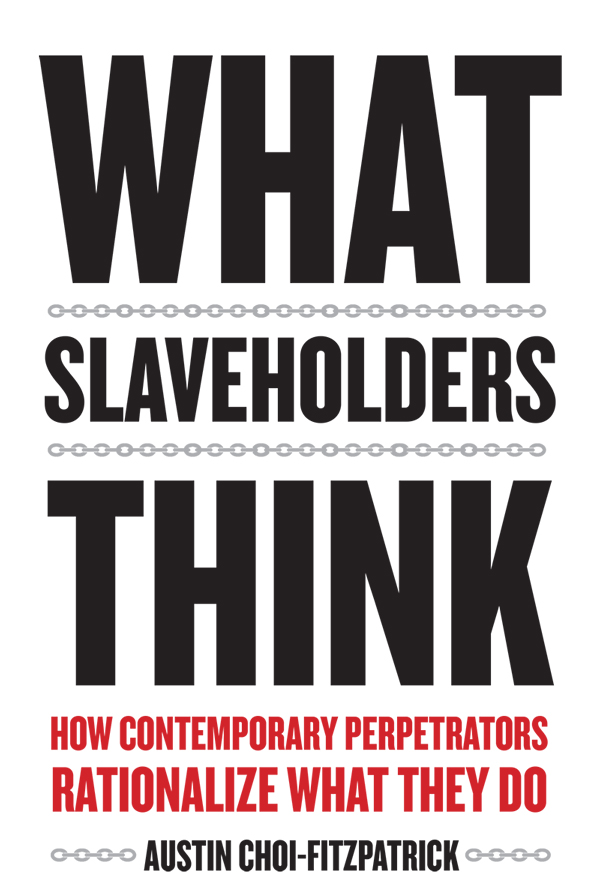
I often get asked why I wrote a book about contemporary slaveholders. Once people get over the fact that slavery still exists they want to know who on earth is out there, right now doing what it takes to exploit their fellow humans in the worst sort of way?
At the moment the contemporary anti-slavery movement has raised over a billion dollars, reduced the vulnerabilities of untold millions, and brought thousands out of exploitation. Yet we know little about the individuals committing these crimes. I’ve been doing this work for almost 20 years and can tell you this: we know as much about slaveholders today as we did about victims two decades ago; hardly anything.
I set out to change that. In conversations with hundreds and hundreds of people—perpetrators and their victims, local government officials and rights activists—a picture of the life and times of contemporary slaveholders began to emerge.
In case after case, slaveholders targeted by human rights groups told me that they missed the old days. They told me that they wished for a brighter future for their children but that they themselves had been overlooked. Rights groups, broad economic factors, powerful political players, and even their victims, now had all the power.
This is quite a contrast from the old days when the people I interviewed in India enjoyed unquestioned control simply as the result of birth. Being high caste was a blank check.
Scholars and activists have long pointed to globalization as one of the key factors that has led to an increase in human trafficking—increased flows of people and goods create new pockets for exploitation.
But reality is more complex, as feudal control in formerly inaccessible rural areas like those I visited for my research are suddenly connected to large economic centers by new roads and new cell phone networks. News of jobs in the city may travel faster than a master’s threat to get back to work.
What surprised me when talking to slaveholders is the fact that these men are often human rights violators as well as a good many other things. Some are wealthy and abusive men that match our stereotypes of the villain, motivated by avarice and comfortable with brutality. This is a truth. But not the whole truth.
Once we talk to perpetrators more of their reality comes into focus. Women are key operatives in child trafficking routes in China—some are mothers themselves. In India many brothels are run by women. In cases of domestic servitude victims report abuse by women and men. Some perpetrates own businesses and pay taxes. Others are entrepreneurs with funding from major aid agencies. But everyone is violating a longstanding right that everyone has to be free from force, fraud and coercion. To be free from slavery.
Some solutions to slavery and trafficking are easier to see once we factor in what slaveholders think. Recognizing that they themselves are only doing what they can to get by doesn’t justify criminality and abuse, but it does suggest that some more traditional development solutions—alternative livelihood projects and microcredit included—may hold potential for emancipation among both perpetrators and victims. Of course. for freedom to be sustainable minds must be changed—that’s why it’s as important as ever to focus community organizing and human rights empowerment efforts at grassroots struggles for freedom.
The goal is not to equivocate between bonded labor and impoverished slaveholders, but instead to emphasize that slavery is relational, emancipation is complex, and the goal of ending slavery in our lifetime will require strategies that address the reality of the situation rather than the way it may appear in our imagination.
Editor’s Note: Former FTS staffer Austin Choi-Fitzpatrick is now a writer and professor at the University of San Diego. All royalties from his new book go to Free the Slaves in the U.S. and Anti-slavery International in London. FTS supporters get a discount when purchasing the book. Visit the FTS online store for details. Austin will be speaking in Washington on March 15th at a special book launch benefit for Free the Slaves, check here for details.