
A slavery survivor from Haiti shared a grisly account of her childhood in restavèk domestic servitude: “I was born on the street in front of a brothel. Prostitutes brought my mother a towel, so she could swaddle me. My father’s mistress was beautiful, and she, too, had a daughter that day, but she died on that day. My father gave me my sister’s name.” — Marie Alina “Tibebe” Cajuste.
A slavery survivor from Florida recounted how she was forced into child prostitution at age 13 while attending high school: “I had sex with a man with a scar. He had AIDS and when he was finished, he told me I was cursed. Thank God I didn’t contract the disease, but many girls died having contracted AIDS from him.” — Katariina Rosenblatt.
A slavery survivor from Cameroon recalled how she thought a childhood journey to the U.S. to get an education would become the American dream: “I thought Will Smith would be my husband and Bill Cosby would be my father.” — Evelyn Chumbow.
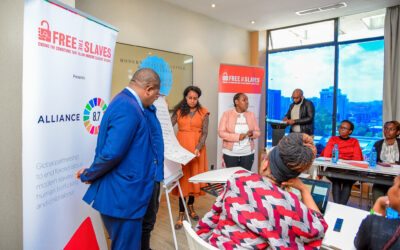
Their personal stories were intense, but their intent was not only to convey the brutality of child slavery. The three women underscored that slavery survivors can recover and lead fulfilling lives. Cajuste, Rosenblatt and Chumbow are now activists helping lead the fight against slavery. Cajuste is a community mobilizer with the group Beyond Borders. Rosenblatt has founded the U.S. group There is Hope for Me. Chumbow is a survivor-advocate for the Alliance to End Slavery and Trafficking (ATEST). They were among the key speakers last week at a day-long conference organized by Broward College, Free the Slaves and ATEST.
Much of the event focused on the practice of restavèk in Haiti—and when it becomes child trafficking. Restavèk is a Haitian Creole word derived from the French phrase, reste avec which means “to stay with.” In Haiti, it is an arrangement where a poor family sends a child to live with a family who will provide food, education and better quality of living in exchange for domestic work. When practiced conscionably, child domestic work creates opportunities for the island’s illiterate and invisible. But for others it leads to overwork, beating, and sometimes raping and maiming children and adolescents.
For Diem Pierre, one of the panelists who works with the Haiti Government Institute for Social Welfare and Research, differentiating restavèk from child work is key to stopping restavèk horrors. “The lines are blurry,” Pierre said. “The word means different things to different people.” He said the government is creating a committee to implement Haiti’s new law against human trafficking.
Human rights organizations like Beyond Borders report a pandemic of restavèk children living in dehumanizing conditions. Cajuste, who works with the group, recalled head-splitting beatings and merciless labor. In her work as a survivor advocate, she recounts an instance where a child’s hands were boiled as a form of punishment.
“Haiti is not an easy place to make things happen,” said Free the Slaves Haiti Director Smith Maximé, regarding the Haitian government’s next steps for eliminating restavèk. “We need a plan, and it’s important for me to see the government take a lead.” Free the Slaves is currently expanding its model communities strategy to create awareness of what can happen to children sent away from home and to empower parents to keep their children out of restavèk.
With an estimated 150,000 to 300,000 children living in restavèk, Coleen Hedglin from Beyond Borders led the discussion regarding communities that are revolutionizing the island’s slavery stigma by facilitating community dialogue and creating community-based protection committees where local residents become active members in abolishing restavèk child domestic servitude.
Also speaking at the conference:
- Broward College Vice President and FTS Board Member Greg Haile
- FTS Executive Director Maurice Middleberg
- FTS Haiti and Ghana Senior Program Manager Christy Gillmore
- Zanmi Timoun Coordinator Guylande Mesadieu
- National Domestic Workers Alliance Campaign Director Andrea Mercado
- Word and Action Executive Director Georges Bossous Jr.
- Child Labor Coalition Coordinator Reid Maki
- Florida State Sen. Maria Sachs
- Haitian diaspora activist Leonie Hermantin
Video presentations were provided by:
- U.S. Senator Bill Nelson (D-FL)
- U.S. Senator Marco Rubio (R-FL)
- U.S. Rep. Ted Deutch (D-FL)
- U.S. Rep. Frederica Wilson (D-FL)