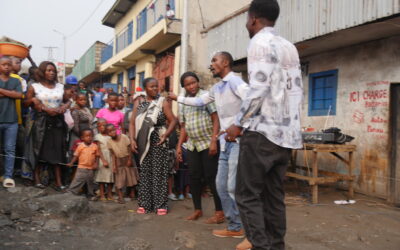
From Slavery to Dressmaking Trainer in the Congo

“My story is hard to tell,” says Benita Furaha, a trainer at a dressmaking training center in Rubaya, Democratic Republic of the Congo. Benita’s parents died when she was 13. Her older brother threatened to starve her or to send her out of the house if she couldn’t contribute to household expenses. One option was […]

By Staff

December 13, 2017

“My story is hard to tell,” says Benita Furaha, a trainer at a dressmaking training center in Rubaya, Democratic Republic of the Congo.

Benita’s parents died when she was 13. Her older brother threatened to starve her or to send her out of the house if she couldn’t contribute to household expenses. One option was to find a husband. Instead, she went to work in the mines.

“Every morning, I transported and sold sorghum juice to the quarry workers,” Benita recounts. “I also transported minerals from the quarry. I worked from 6 a.m. to 6 p.m. and I hardly earned $1 per day.” Benita was also a victim of sexual violence.

In 2012, Benita met community workers from the Free the Slaves partner organization ASSODIP. They encouraged Benita to leave her situation and join the group’s dressmaking center in Rubaya. After several meetings including ASSODIP activists, Benita and her older brother, Benita left the mine to learn dressmaking.

Since then, her life has changed. Benita spent three months in learning dressmaking skills. After the training, she joined the dressmaking workshop in the Rubaya market. At the same time, she took reading and writing classes. She mastered dressmaking skills and became a good seamstress. Benita explained that the dressmaking allows her to earn a decent and honest living.

Benita was able to save enough money to buy two goats and eight chickens. Recently, ASSODIP hired her as the dressmaking trainer for survivors of gender-based violence at the ASSODIP training center in Rubaya.

“I love my job and I want other gender-based violence survivors to learn dressmaking and earn a living like I do. I thank ASSODIP and its partners for supporting slavery survivors.” Benita says. Now, Benita is married, enjoys a good reputation and serves as a role model in Rubaya.

Learn more online about our program in the DRC here.

See more inspiring stories of individuals and entier communities overcoming slavery here.
Can you help end the conditions that cause modern slavery?

Related Posts

Advancing SDG 8.7 in the DRC: Building Capacity to End Child and Forced Labor in the Mining Sector

Advancing SDG 8.7 in the DRC: Building Capacity to End Child and Forced Labor in the Mining Sector

In Lubumbashi, at the heart of the DRC’s mining region, Free the Slaves (FTS) and Alternatives Plus brought together civil society, government, and mining industry stakeholders for a two-day training on Sustainable Development Goal (SDG) 8.7. The sessions equipped local actors with tools to identify, prevent, and eliminate child and forced labor in artisanal mining—turning global commitments into grassroots action.

read more
Exploitation and Extraction: How Armed Groups are Fueling Modern Slavery in DRC’s Cocoa Sector

Exploitation and Extraction: How Armed Groups are Fueling Modern Slavery in DRC’s Cocoa Sector

The Democratic Republic of Congo’s cocoa sector is growing—but so is the exploitation behind it. New research by Free the Slaves reveals how armed groups and corrupt actors are using violence, forced labor, and smuggling to control cocoa production in eastern DRC. As cocoa beans flow into global supply chains, the human cost remains hidden. This new report examines the links between modern slavery and illicit resource appropriation—and what governments, industry, and the international community must do to stop it.

read more
My Journey as a Survivor Leader

My Journey as a Survivor Leader

From surviving human trafficking to leading the fight against it, Bernadette Agano shares her powerful journey of transformation and advocacy. Through her work with Free the Slaves in the Democratic Republic of Congo, Bernadette has empowered fellow survivors, influenced policies, and helped build a national survivor network. Her story is a testament to resilience, solidarity, and the urgent need for action in the fight against modern slavery.

read more